How do Eigenverwaltung proceedings work?
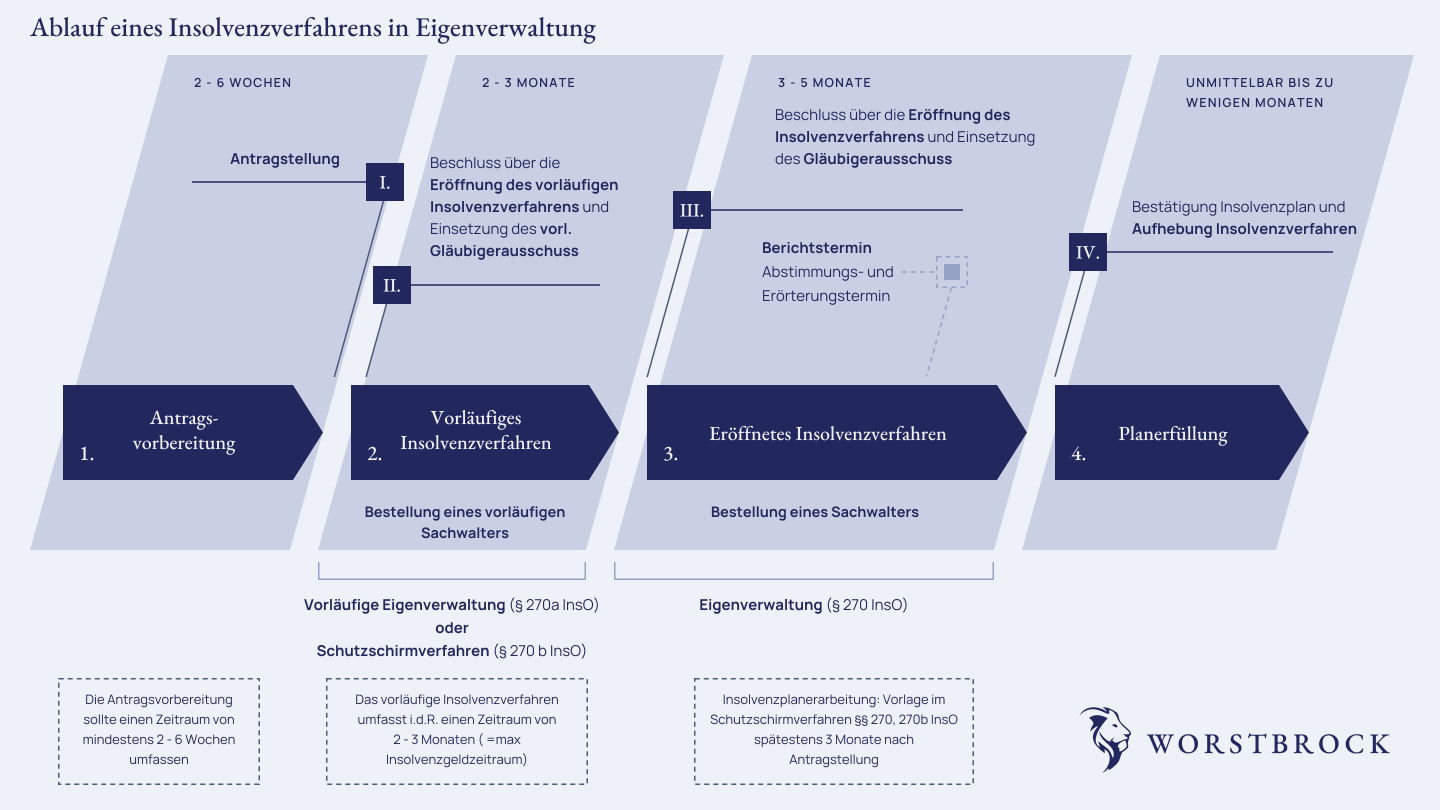
Eigenverwaltung proceedings (debtor-in-possession management under Sections 270 et seq. of the German Insolvency Code) begin with the company’s insolvency application and the application for Eigenverwaltung, on which the insolvency court decides. Where the judge has doubts as to whether Eigenverwaltung is likely to succeed, an expert may be called in. A well-prepared and well-drafted application for Eigenverwaltung, however, increases the likelihood that the judge will approve the application without calling in an expert.
After the application to the court, preliminary proceedings are conducted in order to initiate first measures, protect creditors’ rights and complete the preparations for insolvency benefit (Insolvenzgeld) payments and the opening of insolvency proceedings. In practice, the proceedings are usually opened after around three months, because insolvency benefit secures wages for this period. After that, operational restructuring measures can be stepped up.
In the opened proceedings, the insolvency monitor (Sachwalter) examines possible avoidance claims (Sec. 280 InsO), the reports to the court and creditors are prepared and an Insolvenzplan (the plan creditors vote on in German insolvency proceedings) is drawn up. Once it has been submitted to the court, the creditors vote on the plan in groups. If the majorities required by law approve and the court confirms the plan (Sec. 244 and Sec. 248 InsO), the claims are paid in accordance with the rate set out in the plan.