
Growth financing, also known as growth capital, is capital for a company that wants to grow faster than its current cash flow and its principal bank allow. It finances, for example, new products, entry into new markets, an acquisition or the expansion of production.
It is usually raised in financing rounds. In an equity round, private equity firms or family offices acquire shares, often as a minority stake. In a debt round, growth loans, subordinated loans or bridge financing are added, which do not cost any shares. Every round is based on a robust business plan and a valuation of the company. This determines what share a provider of capital receives for its amount.
The Worstbrock-Group prepares financing rounds, approaches suitable providers of capital and supports due diligence and negotiation through to disbursement.
Yes. Management retains its powers. The insolvency monitor (Sachwalter) supervises, but does not manage. This is the difference from regular insolvency proceedings, in which an insolvency administrator takes over.
The Schutzschirmverfahren (protective shield proceedings under Section 270d of the German Insolvency Code) is the narrower variant: it is only available as long as the company is not yet illiquid, it requires a certificate from an independent expert and it gives the company up to three months to draw up an Insolvenzplan (the plan creditors vote on in German insolvency proceedings) without pressure. In return, the company may propose the insolvency monitor (Sachwalter) itself and is protected against enforcement measures.
The price is the tight timeframe: anyone who comes too late can no longer choose the protective shield. Which route fits depends on the liquidity situation, and this must be calculated reliably for that purpose.
In practice, the proceedings cover their costs from around 15 employees or EUR 1m in annual revenue. Below that, the effort is rarely proportionate.
Why do I have to sign a declaration of assignment, and what does it mean for me?
Many employees feel unsure when they first see a declaration of assignment. That is understandable. However, the declaration is needed for a clear reason: the bank wants to make sure that it will later receive the insolvency benefit (Insolvenzgeld) it has pre-financed.
Important to know:
- The declaration of assignment is not a loan agreement of the employee.
- No wages are waived.
- The employees incur no additional costs as a result.
The declaration only provides that:
- the insolvency benefit is paid by the Federal Employment Agency (Bundesagentur für Arbeit) not to the individual employee,
- but to the bank that has already paid out the wages as part of the pre-financing of insolvency benefit.
In practice, the declaration of assignment and the procedure are explained at a staff meeting .
The Worstbrock-Group prepares this communication together with legal counsel and management and provides clear documents, so that employees know what they are signing and why.
Does insolvency benefit also apply in Schutzschirmverfahren or Eigenverwaltung proceedings?
Yes.
In the Schutzschirmverfahren (protective shield proceedings) and in Eigenverwaltung (debtor-in-possession management under Sections 270 et seq. of the German Insolvency Code) too, insolvency benefit (Insolvenzgeld) can be used and pre-financed if the statutory requirements are met.
What matters is:
- Insolvency proceedings must later be opened, or an application to open proceedings must be rejected for lack of assets.
- Only then is there an insolvency event within the meaning of the law.
If, on the other hand, a restructuring is achieved without insolvency proceedings being opened later, no insolvency benefit is paid. This is why early and realistic restructuring planning is so important.
The Worstbrock-Group, together with legal counsel, supports companies through:
- preparing the Eigenverwaltung or Schutzschirmverfahren proceedings
- coordination with the employment agency
- integrating the pre-financing of insolvency benefit into liquidity planning
What exactly does insolvency benefit cover?
Insolvency benefit (Insolvenzgeld) generally covers the net pay for the insolvency benefit period. It is limited to the applicable contribution assessment ceiling.
Typical components include, for example:
- the current basic salary
- variable remuneration earned during the period, such as commissions
- certain one-off payments, for example pro rata holiday or Christmas bonuses, if they relate to the period or trigger a cut-off date rule
- expenses incurred during the period, such as travel costs
- pay during partial retirement within the statutory framework
Pay components that are not covered by insolvency benefit become insolvency claims. They can be filed for entry in the insolvency schedule. Whether there is later a (partial) payment depends on the available insolvency estate.
For the specific classification in individual cases, the Worstbrock-Group and legal counsel work closely together and coordinate with the employment agency where necessary.
Do I still have to apply for insolvency benefit as an employee?
Yes.
Insolvency benefit (Insolvenzgeld) is not paid automatically, even if pre-financing has been agreed.
Important points:
- Insolvency benefit is only paid if the employee submits an application to the competent employment agency (Agentur für Arbeit).
- The deadline is usually two months after the insolvency event.
- The formal requirements are manageable, but mistakes can still jeopardise the entitlement.
In practice, employees are therefore often supported, for example by:
- the insolvency administrator or insolvency monitor (Sachwalter)
- management in Eigenverwaltung (debtor-in-possession management under Sections 270 et seq. of the German Insolvency Code)
- the Worstbrock-Group and legal counsel as part of an organised “application campaign” at the company
Typical process from the employees’ point of view:
- Wages for the insolvency benefit period are already paid from the pre-financing of insolvency benefit via the bank.
- The application to the employment agency serves to secure the statutory entitlement and to enable payment to the bank.
Without pre-financing, employees would often have to bridge the processing times of the employment agency. This can take several weeks and in individual cases lead to financial difficulties.
What is pre-financing of insolvency benefit and how are wages paid on time in a crisis?
In many proceedings, it is not enough for insolvency benefit (Insolvenzgeld) to be paid at some point. Wages should reach employees’ accounts on time. For this purpose, pre-financing of insolvency benefit (Insolvenzgeldvorfinanzierung) is often used.
The process in brief:
- A bank provides the company with a loan.
- From this loan, the net wages are paid out to the employees.
- The employees sign a declaration of assignment.
- Once insolvency proceedings have been opened, the Federal Employment Agency (Bundesagentur für Arbeit) calculates the insolvency benefit and pays it to the bank.
- This money is used to repay the loan in full or in part. Interest and fees are usually borne by the company or the insolvency estate.
Advantages:
- For employees:
wages and salaries for the insolvency benefit period continue to arrive on time. - For the company:
scarce liquidity is conserved, the business remains stable and the chances of a successful restructuring increase.
The Worstbrock-Group prepares the pre-financing of insolvency benefit together with legal counsel, holds talks with banks and agrees the key points with the Federal Employment Agency.
When is there an entitlement to insolvency benefit?
An entitlement to insolvency benefit (Insolvenzgeld) only arises if an insolvency event has occurred. This is the case, for example, if:
- insolvency proceedings are opened in respect of the company’s assets
- the application to open insolvency proceedings is rejected for lack of assets
- the business is closed down completely and no insolvency application is foreseeably filed
Insolvency benefit can be paid for a maximum of three months before this event . This period is referred to as the insolvency benefit period.
Important:
- Before the proceedings are opened, the Federal Employment Agency (Bundesagentur für Arbeit) does not usually pay out insolvency benefit.
- Without further arrangements, a gap therefore arises: employees are waiting for money, and the company is often no longer able to pay.
This is precisely where restructuring concepts and pre-financing of insolvency benefit come in, in practice.
What is insolvency benefit (Insolvenzgeld) and what is it for?
Insolvency benefit (Insolvenzgeld) is a payment made by the German Federal Employment Agency (Bundesagentur für Arbeit) under Sections 165 et seq. of Book III of the German Social Code (SGB III). It protects employees if their employer becomes illiquid, and at the same time relieves the company.
Key points:
- Insolvency benefit secures wages for up to the last three months before an insolvency event.
- The claim is against the Federal Employment Agency, not against the company.
- Insolvency benefit is financed through a levy paid by all employers. The levy rate is set by law and adjusted regularly.
For employees, this means:
Wages are secured for a limited period, even if the company gets into a crisis.
For companies, this means:
Wages for these three months no longer have to be paid out of scarce liquidity in economic terms. This creates room for the restructuring.
The Worstbrock-Group develops restructuring concepts together with legal counsel, in which insolvency benefit can be an important element in stabilising the company.
StaRUG explained simply
The StaRUG, the German Act on the Stabilisation and Restructuring Framework for Businesses (Unternehmensstabilisierungs- und -restrukturierungsgesetz), is a modern tool for companies that have got into a financial crisis but want to avoid insolvency. It offers the opportunity to take restructuring measures at an early stage and thus remain economically stable in the long term.
How does the StaRUG work?
The StaRUG enables companies to draw up a restructuring plan in order to reorganise debts and reach binding agreements with creditors. The key advantage: this takes place outside classic insolvency proceedings, which is less public and protects the company’s reputation. During this phase, the court can prohibit enforcement measures against the company on application (stabilisation order, Section 49 StaRUG).
The advantages of the StaRUG:
- Early stabilisation: companies can take action as early as the stage of imminent illiquidity.
- Protection against creditor action: on application, the court can prohibit enforcement for up to three months (Sec. 53 StaRUG).
- Binding agreements: creditors must abide by the restructuring plan once it has been approved.
- Flexibility: the procedure can be tailored to the needs of the company and is less formal than an insolvency.
- Confidentiality: unlike public insolvency proceedings, the StaRUG remains largely discreet.
A practical example:
A medium-sized trading company specialising in the import and distribution of high-quality building materials faces financial challenges due to increased transport costs and material prices. To avoid imminent payment defaults, management uses the StaRUG to negotiate new payment agreements with creditors. During the process, the company is protected against legal action and gains time to reduce its business costs and open up new sales markets.
Our role:
The Worstbrock-Group supports companies in applying the StaRUG with commercial expertise and together with legal partners. We help you develop a clear restructuring plan that both convinces your creditors and secures your liquidity. Through our experience in negotiating with creditors and our ability to analyse complex economic situations, we ensure that your company not only survives the crisis, but emerges from it stronger.
Summary:
The StaRUG is a decisive instrument for companies that want to act early and avoid insolvency. With the support of the Worstbrock-Group, you can make this process efficient and sustainable, and secure your economic future.
Eigenverwaltung explained simply
Eigenverwaltung (debtor-in-possession management under Sections 270 et seq. of the German Insolvency Code) is a special procedure in insolvency law that gives companies in economic difficulty the chance to keep control of their business. It allows financial problems to be solved under the company’s own management, while a neutral expert, the insolvency monitor (Sachwalter), supervises the process.
How does Eigenverwaltung work?
Unlike classic insolvency, in which an insolvency administrator runs the company, management remains in office in Eigenverwaltung. It is supported by an insolvency monitor, who ensures that creditors’ rights are protected. Together, a restructuring plan is developed that restructures the debts and enables long-term stability.
The advantages of Eigenverwaltung:
- Preserving independence: management remains able to act and can contribute its entrepreneurial expertise to the restructuring process.
- Lower costs: as no insolvency administrator is needed, the costs of the proceedings can be reduced.
- Quick implementation: stabilisation measures can be taken swiftly, often within a few months.
- Protection against enforcement: during the proceedings, companies are protected against attachments and other enforcement measures.
- Continued operations: the business can be continued without major interruptions.
A practical example:
A medium-sized mechanical engineering company specialising in precision components for the automotive industry gets into financial difficulty when a major customer suddenly drops out. Despite the crisis, the company has a functioning business model and a loyal customer base. Management decides on proceedings in Eigenverwaltung in order to restructure its debts and open up new markets. During the restructuring phase, the business can continue to operate, and important investments in innovation are not stopped. Management is supported by an insolvency monitor, who supervises the process.
Our role (Worstbrock-Group):
The Worstbrock-Group supports companies in Eigenverwaltung with sound commercial expertise and practical advice. We analyse the financial situation, draw up restructuring concepts and coordinate negotiations with creditors. With more than 30 years of experience, we ensure that companies are not only stabilised during the restructuring phase, but also positioned for the future.
Summary:
Eigenverwaltung is a suitable solution for companies that want to keep their management and at the same time improve their economic situation. With the Worstbrock-Group at your side, you gain the support you need to master this challenge.
What is due diligence and why is it important in an asset deal?
Due diligence is the process of carefully examining and analysing a company before the purchase in order to identify all relevant financial, legal and operational risks. This includes examining contracts, assets, legal obligations, finances and business relationships. Thorough due diligence is essential to ensure that the buyer knows exactly what it is taking over and what potential risks exist. It also helps to determine the value of the assets correctly and to identify in good time any risks that should be taken into account in the purchase negotiations. In the context of an M&A (mergers and acquisitions) process, due diligence is therefore an indispensable instrument for structuring the purchase price and the transaction appropriately.
What legal requirements apply to an asset deal in restructuring proceedings?
As with any transaction, there are legal requirements to be observed. These concern in particular the transfer of assets and contracts. Under certain circumstances, an insolvency administrator can challenge an asset deal by way of avoidance if it is regarded as detrimental to the creditors. With careful legal review and early planning, however, many of these challenges can be avoided.
When does an asset deal make sense in restructuring proceedings?
An asset deal is particularly suitable if only certain parts of the company are to be continued or if the company is at risk of insolvency. By selling assets quickly, operations can be maintained and jobs secured.
What role does Eigenverwaltung play in an asset deal?
Eigenverwaltung (debtor-in-possession management under Sections 270 et seq. of the German Insolvency Code) allows the company’s management to remain operationally active while an insolvency monitor (Sachwalter) supervises the process. In this context, the asset deal helps to generate liquidity to finance the restructuring without control of the company having to be given up entirely.
How does an asset deal fit into restructuring proceedings?
In restructuring proceedings, such as insolvency in Eigenverwaltung (debtor-in-possession management under Sections 270 et seq. of the German Insolvency Code), an asset deal is often used to rescue profitable parts of a company. The buyer can acquire precisely those assets that are needed for the business to continue, while problematic liabilities remain with the selling company. This supports the continuation of the business and the preservation of jobs.
What are the challenges of an asset deal?
Although an asset deal offers advantages, such as the selective acquisition of assets, it requires careful planning. Each asset must be transferred individually, which can make the process more complex. The transfer of contracts, such as lease or supply contracts, may require the consent of the contracting parties. In many cases, however, this can be resolved efficiently through thorough preparation and negotiation.
What are the advantages of an asset deal?
An asset deal allows the buyer to take over assets selectively, without taking over liabilities or legacy burdens. This enables the buyer to minimise risks and make targeted investments. It also offers the opportunity to secure jobs and important business relationships, as operations can continue in many cases.
How does an asset deal differ from a share deal?
In an asset deal specific assets are acquired, whereas in a share deal the entire company is acquired, including liabilities and risks. An asset deal allows the buyer to take over only those parts of a company that are valuable to it, which is particularly advantageous if it wants to minimise business risks.
What is an asset deal?
An asset deal is the purchase of individual assets of a company (for example machinery, patents, real estate) instead of the purchase of all the shares in the company. As a result, the buyer only takes over the assets it wants and not the company’s liabilities. This allows a flexible and targeted acquisition of assets.
Who can notify or initiate proceedings under the StaRUG?
Any person capable of being subject to insolvency proceedings, with the exception of natural persons not engaged in business. Proceedings under the StaRUG (the German Act on the Stabilisation and Restructuring Framework for Businesses) can only be initiated for one’s own company, so unlike in insolvency proceedings, it is not possible for a creditor to file a corresponding application against another company.
When can proceedings under the StaRUG be notified or initiated?
Proceedings under the StaRUG can be initiated once the ground for insolvency of imminent illiquidity has occurred. Companies in which the grounds for insolvency of illiquidity or over-indebtedness already exist cannot use the instruments of the StaRUG. For these companies, only a restructuring within insolvency proceedings is possible.
The actual proceedings begin with the preparation of a restructuring plan, which the affected creditors must accept by a qualified majority. This can take place in court proceedings or out of court. If the company wishes to use the court proceedings, it must notify the restructuring project to the competent restructuring court (Section 31 (1) StaRUG). The notification must be accompanied by the draft of a restructuring plan or a concept for the restructuring, an account of the status of negotiations with creditors and an account of the arrangements made to ensure implementation (Sec. 31 (2) StaRUG). Without the need for a court decision, the notification has the effect that the restructuring matter becomes pending and the instruments of the StaRUG can be used for its implementation (Sec. 31 (3) StaRUG).
How do proceedings under the StaRUG work?
The core of restructuring proceedings under the StaRUG (the German Act on the Stabilisation and Restructuring Framework for Businesses) is the preparation of a restructuring plan, through which a company in economic difficulty seeks to arrange its legal relationships in such a way that it does not become illiquid. At the time the plan is drawn up, illiquidity may only be imminent, it must not yet have occurred. The main content of the plan will usually be a debt haircut or a postponement of due dates.
The plan must be presented to the affected creditors, who have to vote on it. This can take place in court proceedings or out of court. In addition, once the restructuring proceedings have been notified to the restructuring court, stabilisation measures can be applied for even beforehand (for example suspension of enforcement and realisation measures against the company).
Likewise, at the company’s request, the court may appoint a restructuring facilitator (who mediates between the parties) or, particularly in more advanced or more difficult cases (in which case also of its own motion), a restructuring officer. The restructuring officer examines and monitors the legal requirements of the restructuring and, depending on the case, may also be given more far-reaching functions (supervision of management and administration of incoming funds, supervision of plan implementation).
If the plan is accepted by the creditors with the required majorities, it must be submitted to the restructuring court for confirmation. If the court confirms the plan, it shapes the company’s affected legal relationships as intended.
If the proceedings fail because the plan is not accepted or not confirmed, this will often result in insolvency proceedings.
How do restructuring proceedings differ from insolvency proceedings?
Restructuring proceedings under the StaRUG (the German Act on the Stabilisation and Restructuring Framework for Businesses) are intended to enable a restructuring without mandatory court involvement or publication, before insolvency proceedings become necessary. They require that illiquidity is only imminent and has not yet occurred, and that the company is capable of being restructured. The company must present its creditors with an appropriate restructuring plan, which must be accepted by a qualified majority of creditors. At the company’s request, supporting court measures may be taken (stay of enforcement, court-supervised voting procedure). The company retains control of its management during the restructuring.
Insolvency proceedings, which apply not only in the case of imminent illiquidity but above all where illiquidity or over-indebtedness has already occurred, and which can also be initiated at a creditor’s request, are by contrast always court proceedings, in which the management of the company is either supervised by an insolvency monitor (Sachwalter) in Eigenverwaltung (debtor-in-possession management under Sections 270 et seq. of the German Insolvency Code) or placed entirely in the hands of a court-appointed insolvency administrator. Ideally, insolvency proceedings also lead to a restructuring of the company (for example by means of an Insolvenzplan, the plan creditors vote on, or a sale to a new legal entity by way of an asset deal). However, the business may also be closed down and liquidated. If the company files its own application early, the proceedings can be conducted in Eigenverwaltung with the support of an insolvency monitor, otherwise the court appoints an insolvency administrator, who then acts for the company. Unlike in restructuring proceedings, in insolvency proceedings contracts can be continued under Sections 103 et seq. InsO without burdening the insolvency estate.
If the restructuring proceedings fail (for example because the required majority of creditors does not agree), they will usually be followed by insolvency proceedings.
What are proceedings under the StaRUG?
StaRUG proceedings (restructuring proceedings under the German Act on the Stabilisation and Restructuring Framework for Businesses) are proceedings, not necessarily before a court, for preserving companies that are in economic difficulty but are still solvent. On the basis of a restructuring plan, and where appropriate with the support of a restructuring officer, such companies can in particular reorganise their liabilities (debt haircut) if a qualified majority of creditors agrees, the creditors are treated equally according to their rank and the measures are appropriate. In addition, enforcement measures against the company can be prohibited with the approval of the court. The proceedings can be conducted without publication.
The proceedings are intended to encourage companies to initiate the measures required to preserve the company themselves as early as the stage of imminent illiquidity, without having to go through court insolvency proceedings.
Are StaRUG proceedings publicly announced?
In restructuring matters under the StaRUG (the German Act on the Stabilisation and Restructuring Framework for Businesses), public announcements are only made if the debtor applies for them. The application must be made before the first decision in the restructuring matter and can only be withdrawn until the first decision (Section 84 (1) sentence 1 StaRUG). Under Sec. 84 (2) no. 2 StaRUG, the information listed in Article 24 (2) of Regulation (EU) 2015/848 must be announced, that is mainly general information on the proceedings and on running deadlines, as well as all court decisions. The public announcement is made by central, cross-state publication on the internet (Sec. 86 (1) StaRUG). IMPORTANT: the public announcement is sufficient proof of service on all parties involved, even if the law also prescribes separate service (Sec. 86 (3) StaRUG).
Where are proceedings under the StaRUG notified?
Proceedings under the StaRUG (the German Act on the Stabilisation and Restructuring Framework for Businesses) must be notified to the competent restructuring court. The competent restructuring court is the local court (Amtsgericht) in whose district the competent higher regional court (Oberlandesgericht) has its seat (Section 34 (1) StaRUG). A different jurisdiction applies if this local court is not responsible for conducting corporate insolvencies. In this case, the local court responsible for corporate insolvencies at the seat of the higher regional court has jurisdiction. In addition, the federal states may assign jurisdiction by statutory order to another local court in the district of the higher regional court (Sec. 34 (2) StaRUG).
What does “imminent illiquidity” mean under the StaRUG?
For the purposes of the StaRUG (the German Act on the Stabilisation and Restructuring Framework for Businesses), imminent illiquidity exists if the company is likely to be unable to meet its existing payment obligations when they fall due (Section 18 (2) of the German Insolvency Code). When examining whether the liquid funds are likely to be sufficient to meet the payment obligations due, a forecast period of 24 months must be applied.
What is a restructuring plan under the StaRUG?
Similar to an Insolvenzplan (the plan creditors vote on in German insolvency proceedings, Sections 217 et seq. of the German Insolvency Code), the restructuring plan under the StaRUG (the German Act on the Stabilisation and Restructuring Framework for Businesses, Sections 2 to 28, 45, 46 and 60 to 72 StaRUG) is a comprehensive reorganisation of the company’s legal relationships, intended to enable the company to be restructured. As a rule, such a plan is drafted by the company’s specialised advisers. Of central importance is the treatment of claims against the company (“debt haircut”) and of rights in assets (for example land) that the business still needs after the restructuring. The plan can also affect shareholders’ rights (for example a debt-equity swap, the exchange of claims for new shares). Employee claims cannot be shaped by a plan. The plan divides the affected creditors into groups according to how they would stand in insolvency proceedings. Within these groups, creditors must in principle be treated equally (although certain groups can be excluded from the outset, for example small creditors or consumers, and appropriate unequal treatment is also possible under certain conditions). The plan is served on the affected creditors in writing. If it is not accepted by all creditors, a vote can be held on it, at the debtor’s request also in court proceedings. In this way, unwilling creditors can be outvoted by an appropriate plan.
What court assistance is available under the StaRUG?
Various court instruments are available under the StaRUG (the German Act on the Stabilisation and Restructuring Framework for Businesses), including the court-supervised plan voting procedure, the preliminary examination, stabilisation measures and court confirmation of a restructuring plan.
Which groups of creditors can be included in the proceedings, and which cannot?
A distinction is made between various groups of creditors under the StaRUG (the German Act on the Stabilisation and Restructuring Framework for Businesses), including secured creditors, ordinary restructuring creditors, subordinated restructuring creditors and holders of shares or membership rights. Employee claims are excluded.
Is there protection against enforcement in StaRUG proceedings?
Yes. In proceedings under the StaRUG (the German Act on the Stabilisation and Restructuring Framework for Businesses), the restructuring court can, on application, prohibit or provisionally suspend enforcement measures if this is necessary to achieve the restructuring objective.
Can creditors be outvoted?
Yes. Under the StaRUG (the German Act on the Stabilisation and Restructuring Framework for Businesses), creditors can be outvoted by a three-quarters majority within their group. The vote is based on the amount of the claims or the value of the right to separate satisfaction.
What are the basic common features of the ESUG and the StaRUG?
Both the ESUG (the German act facilitating the restructuring of companies) and the StaRUG (the German Act on the Stabilisation and Restructuring Framework for Businesses) pursue the common goal of restructuring companies. Both procedures involve drawing up and voting on a restructuring plan: an Insolvenzplan (the plan creditors vote on in German insolvency proceedings) in the case of the ESUG and a restructuring plan under the StaRUG. The focus is on preserving the company’s legal status.
What liability risks exist for those involved?
Those involved, in particular managing directors, bear liability risks that are determined by the interests of the creditors. The StaRUG (the German Act on the Stabilisation and Restructuring Framework for Businesses) provides for liability of corporate officers and sets out liability rules in Sections 43 and 57 StaRUG. It is important to identify and minimise liability risks.
Who manages the business and the restructuring measures in StaRUG proceedings?
In proceedings under the StaRUG (the German Act on the Stabilisation and Restructuring Framework for Businesses), the existing management leads the preparation and implementation of the proceedings. The court may appoint a restructuring officer to monitor the process and protect the interests of the creditors.
Are there differences in the treatment of employee rights under the ESUG and the StaRUG?
A key difference between the ESUG (the German act facilitating the restructuring of companies) and the StaRUG (the German Act on the Stabilisation and Restructuring Framework for Businesses) is that the StaRUG protects employees’ rights, whereas under the ESUG employee rights can be affected in certain cases. This tends to make the StaRUG less suitable for companies that rely on workforce measures.
How are creditors involved in the plan solution under the ESUG and the StaRUG?
In proceedings under the ESUG (the German act facilitating the restructuring of companies), that is Eigenverwaltung (debtor-in-possession management) or the Schutzschirmverfahren (protective shield proceedings) under the German Insolvency Code, all creditors must be included in the plan solution. The debtor company submits a restructuring proposal to all creditors, which is put to a vote. By contrast, the StaRUG (the German Act on the Stabilisation and Restructuring Framework for Businesses) allows individual creditors or groups of creditors to be included, such as banks, landlords or suppliers.
How do the ESUG and the StaRUG differ in terms of the timing of intervention?
A decisive difference is that the StaRUG (the German Act on the Stabilisation and Restructuring Framework for Businesses) comes into play at an earlier stage of a corporate crisis and can be applied before illiquidity occurs. The instruments of the ESUG (the German act facilitating the restructuring of companies), Eigenverwaltung (debtor-in-possession management under Sections 270 et seq. of the German Insolvency Code) and the Schutzschirmverfahren (protective shield proceedings), are by contrast used in formal insolvency proceedings. They are available as early as the stage of imminent illiquidity, and Eigenverwaltung is also available after illiquidity or over-indebtedness has occurred.
What financial aspects play a role in choosing between the ESUG and the StaRUG?
In a state of imminent illiquidity, the instruments of the ESUG (the German act facilitating the restructuring of companies) offer measures that generate liquidity in the opening phase of insolvency proceedings. The StaRUG (the German Act on the Stabilisation and Restructuring Framework for Businesses), on the other hand, does not provide for such a release of liquidity. The choice between the procedures therefore also depends on the liquidity available to the company.
What are the differences between the insolvency monitor (Sachwalter) under the ESUG and the restructuring officer under the StaRUG?
Under the ESUG (the German act facilitating the restructuring of companies), the insolvency court always assigns an independent insolvency monitor (Sachwalter) to the company. Under the StaRUG (the German Act on the Stabilisation and Restructuring Framework for Businesses), the appointment of a restructuring officer is in some cases mandatory, in some cases optional and in some cases not required. Unlike the insolvency monitor, the restructuring officer is not remunerated under the German Insolvency Remuneration Ordinance (Insolvenzrechtliche Vergütungsverordnung), but according to the actual hours worked.
What does übertragende Sanierung mean?
In a transfer of the business by way of an asset deal (übertragende Sanierung), the business operations or part of them are transferred to a new legal entity and continued there, usually in insolvency proceedings. The aim is to preserve the business and stabilise it so that it can operate profitably again in the future. The assets the business needs are transferred by way of an asset deal. The liabilities remain with the old legal entity, and the creditors are satisfied from the purchase price. This allows the business to make a fresh start without its old debts. The advantage of this form of restructuring is that the business continues and jobs are preserved.
What is an insolvency administrator?
The insolvency administrator is a qualified person appointed by the insolvency court to manage the assets of an insolvent company. The administrator’s task is to satisfy the creditors jointly and to the greatest possible extent, by continuing and restructuring the company or by realising its assets. When the proceedings are opened, the right to manage and dispose of the assets passes to the insolvency administrator (Section 80 of the German Insolvency Code), who decides on ongoing contracts, examines avoidance claims and keeps the insolvency schedule.
What is a Schutzschirmverfahren?
A Schutzschirmverfahren (protective shield proceedings) is an instrument of German insolvency law that enables companies in a difficult financial situation to find a solution for their debts before they become illiquid. It is part of the insolvency opening proceedings and is always conducted in Eigenverwaltung (debtor-in-possession management, Section 270d of the German Insolvency Code). On application, the court prohibits enforcement measures against the company, and the company is given up to three months to draw up an Insolvenzplan (the plan creditors vote on in German insolvency proceedings). This allows the company to use time and resources for a restructuring or reorganisation.
The requirement is that imminent illiquidity or over-indebtedness exists, but not illiquidity, and that the restructuring is not obviously futile. This is evidenced by a certificate from a tax adviser, auditor or lawyer experienced in insolvency matters. The application for Eigenverwaltung is a mandatory part of it, as there is no Schutzschirmverfahren in regular insolvency proceedings.
What is the difference between the creditors’ meeting and the creditors’ committee?
The creditors’ committee and the creditors’ meeting are two different bodies that may exist in an insolvency. The creditors’ committee supports and supervises the insolvency administrator (Section 69 of the German Insolvency Code), while the creditors’ meeting is the supreme decision-making body in an insolvency.
What is the creditors’ meeting?
A creditors’ meeting is a formal meeting of the creditors of an insolvent company. These meetings are held during insolvency proceedings and serve to inform creditors about the current status of the proceedings and to give them the opportunity to ask questions and take decisions. The creditors’ meeting is convened and chaired by the insolvency court (Sections 74 and 76 of the German Insolvency Code) and can play an important role in shaping the insolvency proceedings and in distributing the company’s assets to the creditors.
What is the creditors’ committee?
A creditors’ committee is a group of creditors in insolvency proceedings who represent their interests and can influence the course of the proceedings. The insolvency court may appoint one, and for larger companies a preliminary creditors’ committee is mandatory as early as the opening phase (Sections 22a and 67 of the German Insolvency Code). It should include creditors entitled to separate satisfaction, creditors with the largest claims, small creditors and a representative of the employees. Persons who are not creditors may also become members (Sec. 67 (3) InsO). Its task is to support and supervise the insolvency administrator in the management of the proceedings (Sec. 69 InsO). It must approve particularly significant legal transactions (Sec. 160 InsO). The creditors’ committee is therefore an important player in insolvency proceedings and helps to ensure that the proceedings are fair and just for all parties involved.
What is the difference between an insolvency administrator and an insolvency monitor (Sachwalter)?
An insolvency administrator and an insolvency monitor (Sachwalter) are both involved in handling an insolvency, but have different tasks and powers.
The insolvency administrator is a person appointed by the insolvency court to manage the assets of an insolvent company and to realise them in such a way that creditors are satisfied as far as possible. When the proceedings are opened, the right to manage and dispose of the company’s assets passes to the insolvency administrator (Section 80 of the German Insolvency Code). The administrator continues or closes down the business, decides on ongoing contracts and realises the assets.
The insolvency monitor, by contrast, is appointed in certain cases, such as Eigenverwaltung (debtor-in-possession management under Sections 270 et seq. of the German Insolvency Code), and has a different role from the insolvency administrator. The monitor supervises the proceedings and ensures that creditors’ rights are protected and that the proceedings are conducted in accordance with insolvency law. However, the insolvency monitor does not have the comprehensive powers of an insolvency administrator and acts rather as a kind of controller, responsible for ensuring that the Eigenverwaltung proceedings are conducted lawfully and properly.
In short, the insolvency administrator has a more active role in insolvency proceedings, while the insolvency monitor has a supervisory role and ensures that the proceedings comply with the law.
What is an insolvency monitor (Sachwalter)?
The insolvency monitor (Sachwalter) plays an important role in Eigenverwaltung proceedings (debtor-in-possession management under Sections 270 et seq. of the German Insolvency Code). The monitor is appointed by the insolvency court to ensure that creditors’ rights are respected in the proceedings and that all steps are carried out within the framework of insolvency law. In this respect, the insolvency monitor acts as a supervisor, but usually without powers that take effect externally. Creditors file their claims with the insolvency monitor (Sec. 270f (2) InsO), who keeps the insolvency schedule.
The insolvency monitor must carry out these duties impartially and neutrally, always in the interest of all creditors, reports to the creditors’ bodies (creditors’ committee, creditors’ meeting) and is subject to the supervision of the court. It is important that the insolvency monitor always abides by the rules and that the interests of all creditors are protected.
What does illiquid mean?
Illiquidity exists if a debtor is unable to meet its payment obligations as they fall due, such as wages, taxes, invoices and loan instalments (Section 17 (2) of the German Insolvency Code). This may be because the debtor has insufficient liquidity (available money) or because its income is not sufficient to cover its expenses. Illiquidity is a ground for insolvency (Sec. 17 (1) InsO). For corporations, it triggers the duty to file for insolvency.
As a rule, a debtor is to be assumed to be illiquid if it has stopped making payments.
When is a company considered illiquid?
A company is illiquid if it is unable to meet its payment obligations as they fall due (Section 17 (2) of the German Insolvency Code). To determine whether it is illiquid, several factors have to be considered, including the amount of the payment obligations due, available funds and any additional sources of liquidity, such as loans. According to the case law of the Federal Court of Justice, illiquidity is generally to be assumed if a gap of 10 per cent or more of the total liabilities due cannot be closed within three weeks (Federal Court of Justice, judgment of 24 May 2005, IX ZR 123/04).
What is meant by imminent illiquidity?
Imminent illiquidity (Section 18 of the German Insolvency Code) means that a company may not be able to meet its financial obligations, such as wages, invoices or loans, in full and on time. This may be due to a financial crisis, a deterioration in the market situation or other factors. It is important to watch out for signs of imminent illiquidity at an early stage, so that you can react in good time and take remedial action if necessary.
What is a restructuring concept in accordance with IDW S 6?
A restructuring concept in accordance with IDW S 6 (the German standard for restructuring concepts issued by the Institute of Public Auditors in Germany) assesses whether a company is capable of being restructured. It is usually prepared outside insolvency proceedings, for example when banks require this evidence before providing further financing. It is intended to help assess the financial situation and prospects of success of a company. It therefore serves as a basis for decisions by creditors, business owners and courts. The restructuring concept is prepared by an independent expert and must comply with the requirements of the Institute of Public Auditors in Germany (IDW).
The IDW S 6 rules set out the content and requirements such a restructuring concept must meet. It serves as the basis for the further course of action and thus contributes to stabilising and rescuing the company.
Corporate restructuring
Corporate restructuring refers to the process of putting the company back on a stable and profitable course. It is about more than just preserving the company, it is also about protecting the interests of the business owner. There are various ways of carrying out a successful restructuring, such as preventing insolvency, the orderly handling of an insolvency or supporting the continuation of the business. This can be achieved within insolvency plan proceedings or through a transfer of the business by way of an asset deal (übertragende Sanierung). It is important to find an individual solution that meets the needs and objectives of the company.
Corporate crisis: a critical phase for any company
A corporate crisis describes a situation in which the company experiences negative developments in profitability and ability to pay. The survival of the company is at stake and it is important to act quickly. Many different factors can lead to a crisis, such as attachments, payment reminders, liquidity problems or an unfavourable economic situation.
Our support in a corporate crisis
If you find yourself in a corporate crisis and have lost track, we are at your side. We help you assess the situation, draw up restructuring concepts, hold talks with banks and negotiate with creditors. We are your partner in difficult times and support you in overcoming the crisis. Together we find a solution that puts your company back on course for success.
What does over-indebtedness mean?
Over-indebtedness exists if the debtor’s assets no longer cover its existing liabilities, unless it is predominantly likely in the circumstances that the company will continue to operate over the next twelve months (Section 19 (2) of the German Insolvency Code). The assessment is therefore carried out in two steps: first the going concern forecast, and only if this is negative, a statement of over-indebtedness that compares the assets at liquidation values with the liabilities. Over-indebtedness in the commercial balance sheet alone is not yet a ground for insolvency.
What does delay in filing for insolvency mean?
The management of a legal entity, such as a GmbH, UG or AG, and of a partnership without a natural person as a personally liable partner, such as a GmbH & Co. KG, must file for insolvency without culpable delay as soon as illiquidity or over-indebtedness occurs. The deadline is three weeks at the latest after the onset of illiquidity and six weeks after the onset of over-indebtedness (Section 15a (1) of the German Insolvency Code). Imminent illiquidity does not yet give rise to a duty to file.
Anyone who fails to file the application, files it incorrectly or files it late is delaying the insolvency. This is a criminal offence punishable by a fine or imprisonment (Sec. 15a (4) and (5) InsO).
What is an Insolvenzplan?
An Insolvenzplan (insolvency plan, the plan creditors vote on in German insolvency proceedings) is an important element of insolvency proceedings, with the aim of reaching an agreement between a company in financial difficulty and its creditors. The Insolvenzplan describes how the company’s debts are to be paid and which conditions the creditors must accept.
Once the Insolvenzplan has been accepted and the court has issued a decision, the insolvency proceedings are ended and the company is able to act again. The Insolvenzplan marks the end of the restructuring process and constitutes an agreement between the company and its creditors.
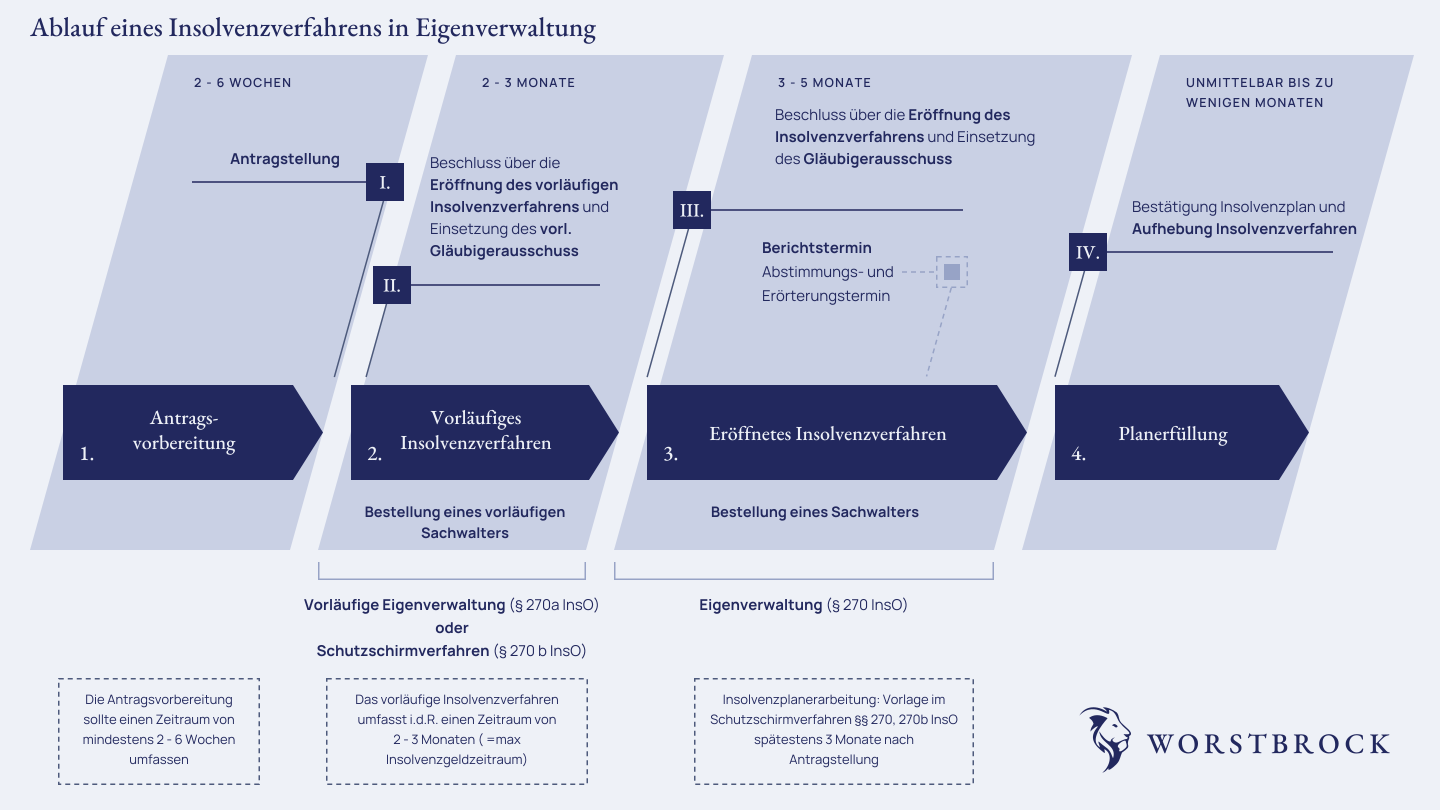
How long do Eigenverwaltung proceedings take?
In our experience, Eigenverwaltung proceedings (debtor-in-possession management under Sections 270 et seq. of the German Insolvency Code) take between 6 and 12 months, depending on the scope and difficulty of the restructuring. It should be noted, however, that this depends on factors such as the size and complexity of the company and the scope of the measures required.
How do Eigenverwaltung proceedings work?
Eigenverwaltung proceedings (debtor-in-possession management under Sections 270 et seq. of the German Insolvency Code) begin with the company’s insolvency application and the application for Eigenverwaltung, on which the insolvency court decides. Where the judge has doubts as to whether Eigenverwaltung is likely to succeed, an expert may be called in. A well-prepared and well-drafted application for Eigenverwaltung, however, increases the likelihood that the judge will approve the application without calling in an expert.
After the application to the court, preliminary proceedings are conducted in order to initiate first measures, protect creditors’ rights and complete the preparations for insolvency benefit (Insolvenzgeld) payments and the opening of insolvency proceedings. In practice, the proceedings are usually opened after around three months, because insolvency benefit secures wages for this period. After that, operational restructuring measures can be stepped up.
In the opened proceedings, the insolvency monitor (Sachwalter) examines possible avoidance claims (Sec. 280 InsO), the reports to the court and creditors are prepared and an Insolvenzplan (the plan creditors vote on in German insolvency proceedings) is drawn up. Once it has been submitted to the court, the creditors vote on the plan in groups. If the majorities required by law approve and the court confirms the plan (Sec. 244 and Sec. 248 InsO), the claims are paid in accordance with the rate set out in the plan.
What does ESUG stand for?
The German act facilitating the restructuring of companies (Gesetz zur weiteren Erleichterung der Sanierung von Unternehmen, ESUG) of 7 December 2011 essentially came into force on 1 March 2012. It strengthened Eigenverwaltung (debtor-in-possession management) in insolvency proceedings. Under Section 270 of the German Insolvency Code, the existing management continues to run the company in Eigenverwaltung, supervised by an insolvency monitor (Sachwalter) instead of being replaced by an insolvency administrator. This applies to companies of every legal form, the only exception being consumer insolvency proceedings.
Anyone applying for Eigenverwaltung submits Eigenverwaltung planning under Sec. 270a InsO: a financial plan for six months, a concept setting out the objective and measures, the status of negotiations with creditors, the arrangements for fulfilling obligations under insolvency law and the expected additional or reduced costs. If the planning is complete and conclusive, the court orders preliminary Eigenverwaltung under Sec. 270b InsO.
If the company is still solvent and illiquidity is only imminent, or if it is over-indebted, the Schutzschirmverfahren (protective shield proceedings) under Sec. 270d InsO may be an option. With a certificate from an adviser experienced in insolvency matters, the company is given up to three months to submit an Insolvenzplan (the plan creditors vote on in German insolvency proceedings).
What is insolvency in Eigenverwaltung?
“Insolvency in Eigenverwaltung” (debtor-in-possession management under Sections 270 et seq. of the German Insolvency Code) means that the company is continued in insolvency proceedings by its own management instead of by an insolvency administrator. The insolvency court orders it at the debtor’s request and appoints an insolvency monitor (Sachwalter), who supervises management (Sections 270 et seq. InsO). Eigenverwaltung is one way of restructuring and reorganising a company when insolvency cannot be avoided, but the company still has a business worth continuing and positive prospects for the future. This form of insolvency allows the debtor to keep control of the company by retaining the power of disposal and control over its finances.
Unlike traditional insolvency proceedings, in which the management of the company is transferred to the insolvency administrator, the debtor remains in charge in Eigenverwaltung.